The Long Leash: Britain's Kite Aerial Photographers and the Slow Sky
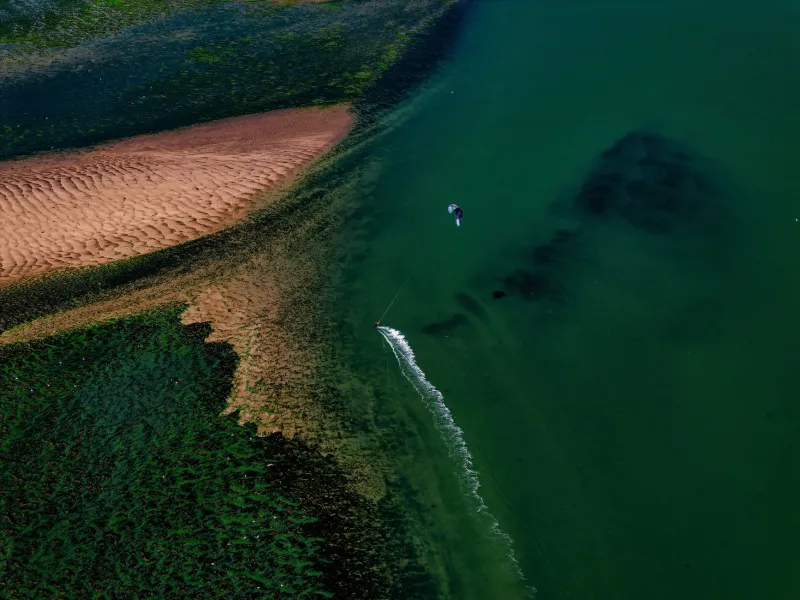
It is a Saturday in late October on the saltmarsh behind Blakeney, and the wind is doing that thing where it leans on the reeds and then lets go. A man in fingerless gloves is paying out line — 50lb Dyneema, then 100, then 200 feet of it — while above him a two-and-a-half-metre delta holds a steady angle and a small camera dangles beneath a wooden cross on a harness of pulleys. There is no controller. There is no app. There is a bloke, a kite, and about four minutes of waiting before the shutter trips on its interval timer.
This is kite aerial photography — KAP, if you're in the club — and it is the least fashionable and most compelling way to get a camera into the sky in Britain right now. In a 2026 where the drone aisle of any camera shop is a wall of gimbals and geofencing, the KAP crowd are still flying plywood.
The rig is a dowel, a pulley and a stubborn idea
The suspension system is called a Picavet, and it was invented in the 1880s by a Frenchman, Arthur Batut, who wanted to photograph his village from above. It is a cross of wood threaded with a single loop of line through four pulleys, and its whole job is to keep the camera level while the kite above it swings. It looks like something a child would make in a technology lesson and it works better than it has any right to.
Depending on who you ask, the camera underneath is a secondhand compact, a GoPro in a housing, a small mirrorless body, or — increasingly — a 360 camera, which has the neat side effect of letting you re-frame the shot afterwards. Shutter release is a servo, an intervalometer, or, in one memorable case, a rubber band and a lot of nerve. Kites run from cheap deltas to Sutton Flowforms, Rokkakus and big soft foils that pull like a horse.
The British scene is small — a few hundred people at most, connected by a couple of long-running forums, the odd kite festival in Bristol or Portsmouth, and a shared willingness to stand on a beach in February. It is not a scene that trends. It is a scene that turns up.
Wind is the co-author
A drone pilot composes a frame. A kite photographer negotiates one. The camera is never quite where you left it, the kite breathes with the gusts, and your exposure is often 1/250th at best because nothing is truly still. You shoot in bursts, you get forty near-misses, and then one frame lands with the right lick of shadow across an estuary and the tide line doing something you couldn't have drawn.
That is why the pictures have a particular quality. Because the camera sits at the end of a long line, it tends to shoot at a lower, more oblique angle than a drone hovering at 120 metres — a rake across the landscape rather than a flat map of it. Rooftops keep their depth. Hedgerows read as hedgerows. Festival crowds at somewhere like Latitude or Glastonbury turn into a soft weave of colour and tents that a top-down drone shot flattens into confetti.
It is also unusually good at slow subjects. Practitioners on the Norfolk and Holderness coasts have been returning to the same eroding clifftops for years, building sequences that show a caravan park losing its edge by a metre a season. Try that with a drone and the batteries will have died of old age before the story is told.
Altitude comes with paperwork
Flying a kite is not flying a drone, and the two are regulated differently — but the sky is shared, and the KAP community takes that seriously. The Air Navigation Order's rules about endangering aircraft and about flying near aerodromes apply to kites just the same, which means a phone call before you set up near an airfield, a look at the local NOTAMs, and an honest assessment of whether that lovely field is under a approach path.
Then there's the ground-level admin. Landowner permission, National Trust or council bye-laws on popular clifftops, insurance through a model flying association or a specialist policy, and a working understanding of what you can and can't do with pictures of identifiable people. Launching is a two-person job: one on the line, one on the kite, gloves on, anchor stake in, and a clear run of grass away from power lines and livestock.
The safety choreography is unglamorous and constant. Know your wind window. Know what a gust looks like coming across water. Know when to bring it down, which is usually earlier than you'd like.
What a drone flattens, a kite keeps
The great argument for all this patience isn't nostalgia. It's that the constraints produce a different picture. A drone gives you control and a clean frame; a kite gives you drift, accident and a slightly wonky horizon that turns out to be the best thing in the shot. The wind decides. You just make sure the camera is pointing roughly the right way when it does.
There is also the small matter of how it feels. Nobody has ever had a firmware update ruin a morning on a saltmarsh. The kite tells you about the weather before the forecast does — you can feel a change in pressure through the line — and the whole operation runs on met Office apps, tide tables, a flask and the willingness to come back next week if it doesn't happen today.
The long wait
Icarus, famously, flew too close to the sun. These lot keep their boots in the mud and send the camera up instead, on 300 feet of line and a wooden cross, and wait for the wind to make a decision. It is slow, faintly ridiculous, and produces images no drone ever could — because they were never entirely the photographer's to make.
If you see a kite over a British beach this winter, hovering with unusual intent, look closer. There's probably a camera under it, and someone with cold hands grinning at the back of a screen.