Clouds by the Yard: The Scenic Painters Making Weather for British Film
There is a particular smell to a scenic workshop: size, sawdust, wet pigment, and the faintly medicinal tang of a brushed-on sky that has not quite dried. It is not the smell of a film set. It is the smell of the bit before the film set — the quiet, dusty, enormously practical bit where someone has to decide what the horizon looks like and then make it exist at forty feet wide.
I am standing in a converted grain store somewhere off a Home Counties lane, watching three people paint a cloud. Not a small cloud. A cloud with a wingspan. It is being built in sections on a wooden frame, laid flat, then hauled upright on a scaffold so the painters can step back and judge it from the sort of distance a camera might actually see it. From close up it looks like bruised cream and grey smudges. From the far end of the shed it looks like an English afternoon about to make a decision.
This is the work of the scenic artist, a trade that sits somewhere between painting, carpentry, theatre, and weather forecasting. The studios that still do it for film, television, theatre, and stills photography are not museums. They are workshops with deadlines, invoices, and a van outside with the back doors open. The romance is real, but so is the drying time.
The smell of size and sawdust
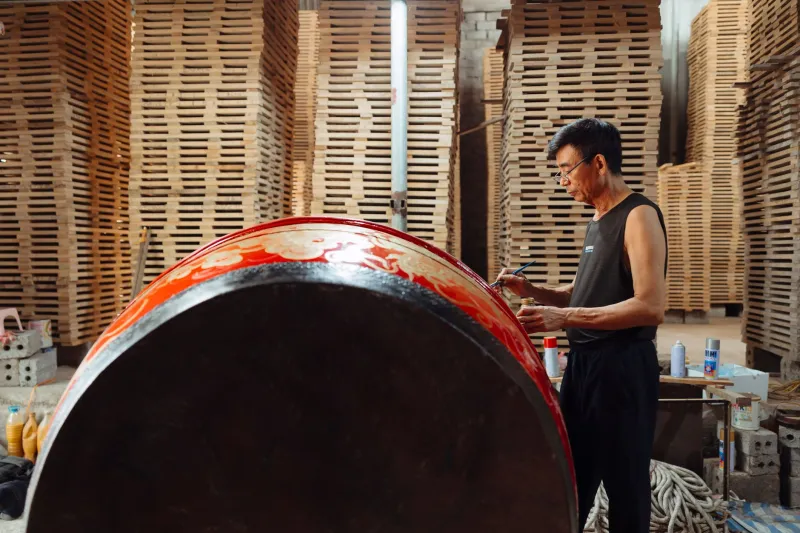
The first thing that surprises you is the scale of the brushes. Some are brooms. Some are homemade pads of foam and cloth lashed to poles. One painter uses a garden sprayer to lay in a soft band of distance, then works back into it with a rag. The sky is not painted so much as built in layers: a ground of pale blue, a warm underbelly for the cloud, a cooler shadow, a few decisive strokes where the light is meant to break through.
Nothing about it is precious. The canvas — often muslin or canvas stretched over a timber frame — is treated like a wall, because that is what it becomes on set. It will be lit, gelled, smoked, rained on, and probably walked past by someone carrying a cup of tea. The painting has to survive being a piece of equipment.
The workshop’s walls are lined with half-finished landscapes: a moorland ridge, a section of sea, a very convincing bit of municipal brickwork. There are coffee cups on trestles and a radio doing something cheerful and indistinct. It feels less like a temple to craft and more like a garage where the cars happen to be skies.
From thumbnail to forty-foot horizon
The process starts small. A production designer or photographer arrives with a script page, a mood board, a location photograph, or sometimes just a sentence: “We need the feeling of the coast without actually going to the coast.” The scenic artist sketches a thumbnail, usually in gouache or pencil, and the thumbnail is argued over. Colour temperature. Cloud height. Whether the horizon should sit low and hopeful or high and oppressive.
Then comes the drawing-up. The design is scaled onto the canvas using a grid, a projector, or the old-fashioned method of standing back and squinting. The painters block in the big shapes first. Only later do they add the small stuff — the scratch of trees on a ridge, the pale line of a distant town, the sort of detail that reads as truth from thirty feet away but looks like loose scribble up close.
That distance is the whole trick. A backdrop is not a painting to be admired in a gallery. It is a painting to be believed through a lens, under lights, for a few seconds or a few minutes. The scenic artist is always painting for the camera’s eye rather than the human one, which means exaggerating contrast, simplifying texture, and resisting the urge to fill every inch with information.
Why directors still order weather by hand
You might assume this is nostalgia. It is not. A painted backdrop does something digital skies often struggle with: it exists in the same room as the actors. It has a surface. It catches light in a particular way. It can be slightly imperfect, and that imperfection can be useful. A real cloud has soft edges and awkward lumps. A painted cloud can have those too, because a human hand made it.
There is also the matter of speed. A production can change its mind about the time of day on a Tuesday and have a new sky by Thursday. No render farm, no compositing schedule, no conversation about whether the horizon line matches the plate. The backdrop is not an effect added later. It is a thing on set, and things on set can be adjusted with a brush and a bad temper.
And there is the pleasure of it. Directors like standing in front of a painted horizon. Photographers like the way it behaves behind a subject. Actors like having something to look at that is not a green rectangle. The craft survives because it is useful, not because it is quaint.
The photography problem
Stills photographers come to these workshops for the same reason film productions do, but with a different set of demands. A portrait photographer might want a soft, abstract sky that does not compete with a face. A fashion shoot might want a hard, theatrical landscape that can be lit like a set. A documentary project might want a backdrop that feels like a memory of a place rather than the place itself.
Painted backdrops are also forgiving in a way that printed vinyl can struggle to be. They can be repainted, patched, aged, and re-hung. They can be made in odd sizes for awkward rooms. They can be a colour that does not exist in nature but does exist in the photographer’s head.
What the brush knows
Back in the workshop, the cloud is nearly finished. One painter steps back, tilts their head, and adds a single pale stroke near the top. It is not a big gesture. It is the sort of adjustment that would be invisible in a photograph of the workshop but obvious on screen. Then they climb down, and someone puts the kettle on.
The sky will be rolled, labelled, and loaded into a van. It will go to a studio, a theatre, or a location shoot. It will be lit and photographed and probably admired by nobody except the people who need it to work. And then it will come back, perhaps, to be repainted for another job.
That is the quiet adventure of the painted horizon. It is not about pretending digital tools do not exist. It is about knowing what a brush can do that a pixel cannot: make a sky that smells faintly of size and sawdust, and that exists, for a while, in the same room as the people standing beneath it.