Designed to Come Apart: The British Workshops Making Icarus Safe to Fail
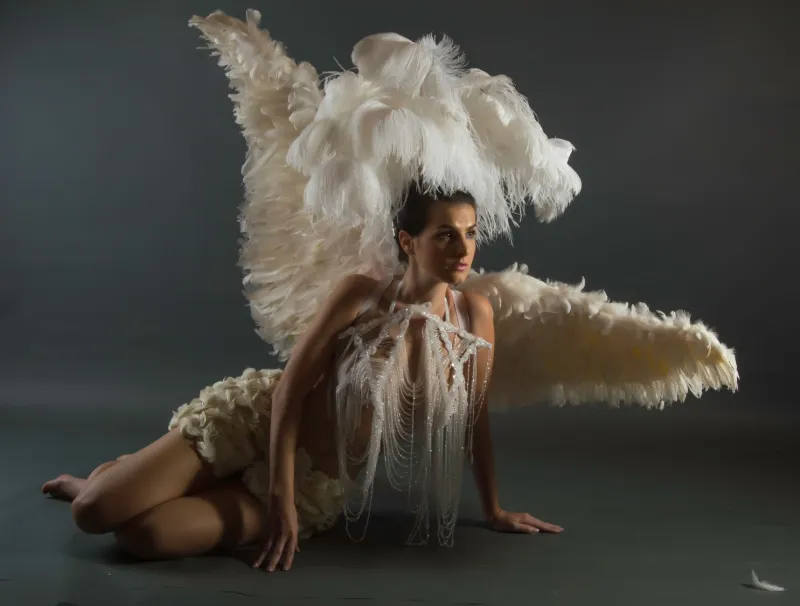
On a wet November morning, a workshop on the edge of Bristol smells of beeswax, hot glue and the faintly metallic tang of wire. A pair of Icarus wings rests on a trestle table, each one longer than a grown adult is tall. They are beautiful in the way that theatre props often are: slightly too romantic to be practical, slightly too practical to be purely romantic. Feathers are layered in overlapping rows, some dyed a soft ash-grey, others left the colour of weak tea. From a distance they read as something out of a Renaissance painting. Up close, you can see the joints.
That is the point. These wings are not built to fly. They are built to be believed for the length of a shot, a scene or a photographer’s flash — and then to come apart in a way that harms nobody.
The Brief Is Not Flight. It Is Belief.
“People say Icarus wings and they imagine something airy,” says a prop maker who has spent the morning trimming goose feathers with nail scissors. “But the first question is always: what happens when the actor turns too quickly? What happens when the light rig gets hot? What happens if someone stands on a trailing wire?”
The answer, in this workshop and others like it around the UK, is a kind of controlled failure. The wings are designed with breakaway points: magnetic clasps, sacrificial wire loops, waxed thread that gives before skin does. The featherwork is deliberately uneven in weight. The armature is light — aluminium, sometimes carbon fibre, often a mix of both — but it is not rigid. A wing that refuses to flex is a wing that will fight back. A wing that flexes too much becomes a noodle.
The romantic materials still matter. Wax is used to stiffen feather stems and to dull the shine of synthetic quills. Wire shapes the curl of a primary feather and gives the whole object its drawn-line silhouette. But the wax is not there to make the wing waterproof. It is there to make the wing look as if it grew. Under a camera, that is a different kind of engineering.
Wax, Wire and the Honest Joint
In the corner of the workshop, a costume maker is stitching a harness that will sit under an actor’s shirt. The wings attach at the shoulder blades, not the spine, and the weight is distributed across a padded yoke. The harness looks more like climbing kit than costume. That is deliberate. The most dramatic object in the room has to be the least dramatic thing to wear.
“You want the audience to see feathers,” says the maker. “You do not want them to see the actor thinking about their shoulders.”
The featherwork itself is a small industry of patience. Goose feathers are sorted by size, then dyed in batches. Cheap craft feathers are blended in for the underlayers, where nobody will look. The top rows are placed by hand, each one angled to catch light in a way that suggests movement even when the wing is still. On set, a still wing can look dead. A wing that shivers slightly — because it is built with a little give — looks alive.
That give is also a safety feature. In one test, a wing is hung from a rig and struck with a sandbag on a pendulum. The aim is not to prove it is strong. The aim is to see which joint fails first and whether it fails quietly. A snapped wire can whip. A magnet can release. A waxed thread can part with a soft tick. The workshop prefers the soft tick.
Rehearsing the Fall
Later, in a studio across town, a photographer is shooting an editorial spread inspired by the myth. The wings are mounted on a standing model who is, quite sensibly, not going anywhere near a ledge. Two assistants hold fishing line attached to the wingtips. The line is invisible on camera and completely visible to anyone standing to the side. The model leans forward. The assistants pull. The wings lift.
It is a trick as old as theatre, and it still works. The photographer wants the moment before the fall — the impossible second when the body has not yet remembered gravity. The wings are not asked to carry the model. They are asked to cast a shadow, catch a rim light, and suggest that the air is holding its breath.
Between setups, a technician checks the wing joints with the flat of a hand. Feathers have shed onto the floor. A waxed thread has loosened. Nobody panics. The wings are meant to be maintained in the same way a dancer’s shoes are maintained: not because they are fragile, but because they are worked.
Under the Lights
British studios are hard on props. The weather outside is wet; the lights inside are hot; the schedules are tight. A wing that looks magnificent in a cold workshop can go limp under tungsten. A feather that reads as silver on a monitor can read as pigeon-grey in the flesh. Prop makers talk about “lighting for the object” — building in enough tonal variation that the wing survives whatever the gaffer does.
That is why the best Icarus wings are never one colour. They are ash and chalk and weak tea, with a few darker quills near the shoulder to give the eye somewhere to rest. They are built to be seen in fragments: a wingtip in the corner of a frame, a shadow on a wall, a blur of feathers as the actor turns. The whole object is rarely the point. The suggestion is.
And when the shot is done, the wings come off. The harness is unclipped. The feathers are brushed. The joints are checked. The myth goes back on its stand, waiting for the next camera to ask it to pretend.
Icarus Studios is not in the business of flight. Neither, really, are the workshops. They are in the business of the controlled fall — the beautiful, breakable, carefully rehearsed moment when something looks as if it might leave the ground.