Frames Before the Frame: The Pencil Work That Quietly Builds a British Film
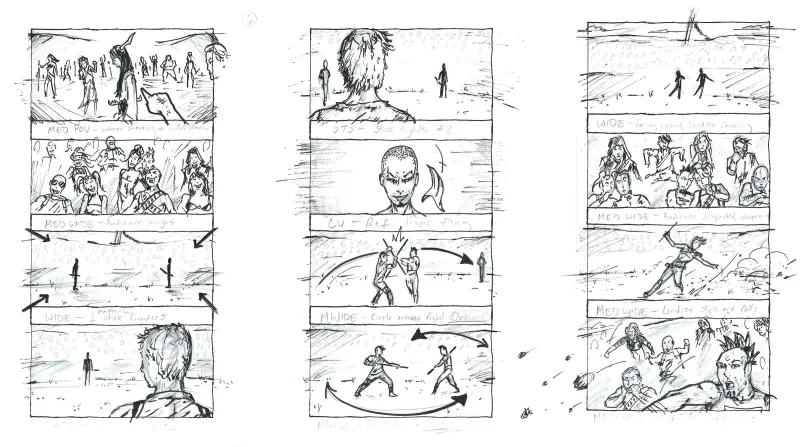
Photo: storyboard artist hand drawing film frames pencil sketches desk, via blog.pond5.com
There is a moment, somewhere in the limbo between a script being greenlit and a crew actually existing, when a film is nothing but a stack of drawings. Not glamorous ones, necessarily. Coffee rings on the corner. A camera arrow that looks like a comma. A little stick figure standing in for an actor who hasn't been cast and might never be.
Those drawings are the work of storyboard artists, and they are among the most influential people on a British production whom nobody outside the industry could name. Their frames decide where the camera goes, how a chase reads, how close we get to a face before the argument lands. By the time a director is standing on a wet car park in February, the shape of the sequence was settled months ago — at a kitchen table in Leeds, or a converted bedroom in Cardiff, or a corner of a Soho office with the blinds half down.
The Very First Cut of the Film
"You're directing the scene before the director does," one board artist told me, laughing, as she shuffled a pile of A4 into some private order. "You have to be the audience's eyes and the cameraman's shoulder and the editor's cut all at once."
That's the strange gravity of the job. A storyboard isn't illustration — it's logistics wearing a smock. Every panel secretly answers a producer's question: can we actually shoot this? How many setups? Where does the light fall? A good board communicates the feeling of a shot and the cost of it in the same breath, which is why the best artists in the UK are innately a bit ruthless. They'll draw you a gorgeous sunrise, then draw the five-foot crane you'd need to get it.
The lineage here is genuinely old. British cinema has leaned on boards for decades — the tradition runs from the tight, propulsive frames drawn for the great British thrillers of the mid-twentieth century right through to the blockbuster work that now fills the soundstages at Pinewood and Shepperton, and the busy Cardiff studios pulling in major productions. Somewhere in that history is a lesson still being taught: that the board is not a doodle, it's a contract.
The Tools Are Cheaper Than You'd Think
What surprised me most, visiting artists in their various corners of Britain, is how little the setup has changed. A favourite pencil. A lightbox for tracing up a rough. A Moleskine, or, more honestly, a spiral pad from a supermarket. One artist working regularly on large features still boards entirely with biro and a highlighter, scanning panels on a flatbed that must be older than some of the runners on set.
"People expect a whole rig," another said, tapping a battered tablet that had seen better days. "It's a pen. It's my hand. The rest is troubleshooting."
The digital shift, though, is real and it's reshaping the craft. Studios increasingly want boards delivered inside previs software — three-dimensional, lit, movable, with a virtual camera you can fly through the room. At that point the artist is less drawing a shot than building it. For sequences like action, sci-fi, or anything involving heavy VFX plates, this makes obvious sense: the visual effects team needs data, not atmosphere, and a 3D blockout tells the whole pipeline exactly what the shot requires.
Where the Pencil Still Wins
And yet. Ask a director about a quiet two-hander, a confession in a kitchen, a long slow walk across a drizzly beach, and most will still want ink, not geometry. Because the great hand-drawn board has something a blockout doesn't: atmosphere. A wobble in the line. A shadow falling the wrong way that somehow evokes the mood you're chasing. A panel that is a bit scruffy and a bit alive.
"Software gives you clarity," one artist explained. "Pencil gives you an argument. If I draw it rough, the director feels free to push back. If I build it in a machine, everyone assumes it's decided." That's the real cost of full previs: not money, not time, but the loss of the tentative. A three-dimensional shot looks finished, and finished shots stop the conversation before it starts.
The best UK artists I spoke to have made a working truce between the camps. They'll scout a scene in loose pencil first, get the design of the sequence agreed on paper where it's cheap to change, then translate the locked version into a proper digital board for the crew. Roughness, then rigour.
The Skill Nobody Puts on the CV
There is one skill that comes up again and again, and it isn't draughtsmanship. It's listening. A storyboard artist works directly from a director's frantic verbal shorthand — "then it's like, you know, that thing where the light goes wrong" — and turns it into a legible picture without ever quite hijacking the direction.
"You're a translator, really," one said. "The director has the film in their head. It's your job to get it out, fast, before the confidence goes."
That speed is part of it. Boards are often needed overnight, for a pitch, a financier, a last-minute recce. The drawings that end up shaping a well-loved sequence are frequently the ones produced at two in the morning by someone who has not yet been paid. It's a quiet, precarious craft, and the artists who keep it alive are doing something close to what this studio loves most — making the invisible visible, on the cheap, before anybody's watching.
So next time you sit in a cinema and a camera move feels inevitable, the way it slides down a corridor or holds a face a beat too long, consider that someone pencilled that decision in a spiral pad months ago. The film you're watching is the third or fourth version. The first was drawn, and you'll never see it.