The Black You Can Hold: Britain’s Shadow Makers and the Art of Negative Light
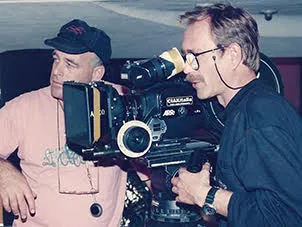
Photo: MZ468, CC BY-SA 4.0, via Wikimedia Commons
On a grey November morning in an industrial unit off the M62, the brightest thing in the room is a piece of black cloth. A gaffer from Salford pins it to a frame, angles it just past a window, and the whole set changes. The light has not been dimmed. It has been edited. What falls across the wall is not absence, exactly. It is a shape with intention.
This is the quiet work of the shadow department — the crews who design darkness before anyone thinks to call it lighting. They are gaffers and sparks, set craftspeople and still-life photographers, prop makers and painters. They work with flags, cutters, gobos and homemade shadow-makers. They treat shadow as a material you can hold, fold and hang. In an age when a scene can be relit in post or on an LED wall, their craft remains stubbornly physical, and often more inventive than the software.
A Unit Off the M62
The gaffer — let’s call her Ellen, because she asks not to be named while the job is live — is prepping a kitchen-sink drama that needs to look like a wet Tuesday in a northern town. The window is a sheet of diffusion. The sun is a 2K bounced off a poly board. But the real work is happening at the edges: strips of blackwrap curling around the frame, a cutter slicing the light into a narrow blade, a flag hovering just out of shot to keep the ceiling from going milky. ‘People think lighting is about adding light,’ she says. ‘Half the job is taking it away. The camera doesn’t see a lamp. It sees the contrast between what’s lit and what isn’t. That’s the picture.’
Her kit is a portable grammar of subtraction. Solids, fingers, dots, teasers, cutters, gobos. A cucumber frame with a branch taped to it becomes a tree outside a window. A sheet of perforated metal throws a grid across a hospital corridor. A strip of lace, bought from a market in Leeds, makes a bedroom feel like it belongs to someone’s nan. None of this is new. What is new is how deliberately it is being designed, drawn and tested before the shoot day.
The Grammar of Flags
In a studio in Peckham, a still-life photographer is building a black that you could almost cut with a knife. The subject is a ceramic bottle. The brief is ‘quiet luxury, but not shiny’. The photographer has three lights, two flags and a piece of black card that has been curved by hand. The shadows are not a by-product. They are the product. ‘A product shot lives or dies on the edge of the shadow,’ she says. ‘Too soft and it looks like a catalogue. Too hard and it looks like a crime scene. You’re sculpting the falloff. You’re deciding where the eye rests.’
Her tools are humble: Duvetyne, blackwrap, a set of gobos bought from a theatre supplier in Croydon, a homemade snoot made from a Pringles tube and gaffer tape. The Pringles tube is not a joke. It is a precise instrument. It makes a small, hard pool of light that can be moved millimetre by millimetre. The shadow around it becomes a frame. The frame becomes the mood.
Handmade Darkness
Not all shadow-makers are gaffers. Some are scenic painters, prop makers or model-makers who build physical objects specifically to cast the right pattern. A workshop in Bristol has a shelf of what it calls ‘shadow stock’: branches, dried flowers, wire mesh, old lace, a plywood window frame with irregular glazing bars. These are not props in the conventional sense. They never appear on camera. They exist only to interrupt light.
One maker describes the process as ‘drawing with a scalpel and a lamp’. He cuts card into shapes that will read as foliage, then tests them against a wall with a phone torch. ‘You’re not making a tree,’ he says. ‘You’re making the idea of a tree at 4pm in October. The shadow does the acting.’
This is where the department becomes a design studio. The best shadow work is not realistic. It is legible. A window pattern does not need to match the actual window. It needs to tell the audience what kind of room they are in, what time it is, whether someone is home. A slatted blind across a face says one thing. A lace curtain says another. A hard-edged square of light on a wall says ‘institutional’. A soft, wobbling leaf pattern says ‘garden’. The shorthand is learned, but it is also made fresh on every job.
Why Physical Shadow Still Matters
You might think virtual production would have killed this craft. Why build a cucoloris when a wall of LEDs can render any pattern you like? The answer is texture. Digital shadows are clean. Physical shadows are not. They have dust in them. They have the slight wobble of a flag moving in a draught. They have the irregular edge of a hand-cut card. That imperfection reads as truth, even when the audience cannot say why.
And there is the practical joy of it. A gaffer with a roll of blackwrap and a sharp knife can solve a problem in five minutes that would take a week in post. A photographer with a piece of black card can make a product feel expensive without a single plugin. The shadow department is not resisting technology. It is using the oldest technology there is: blocking light.
On the M62 unit, Ellen switches off the last lamp and lets the set settle into its final shape. The room is not dark. It is full of controlled black. ‘That’s the shot,’ she says. ‘Everything else is just illumination.’